

Written by Aisha Saleem, Pharmacist & Health Writer at PharmaHealths.com
Last Updated: August 2026
Eczema on the face is one of the most distressing presentations of the condition. The skin on the face is thinner, more visible, and more socially exposed than skin elsewhere on the body, and the proximity to the eyes, nose, and mouth means that both the symptoms and the treatment options are more constrained than they are for body eczema. Patients frequently ask me whether the eczema on their face is the same condition as the eczema on their arms and legs, why it behaves differently, and why their usual emollient or steroid cream cannot simply be applied to the face in the same way.
The short answer is that facial eczema and body eczema share the same underlying biology but differ significantly in presentation, trigger sensitivity, and treatment approach due to the structural and physiological characteristics of facial skin.
Why Facial Skin Is Different
Facial skin is structurally distinct from skin on the body in several ways that directly affect how eczema presents and how it responds to treatment.
Facial skin is significantly thinner than body skin, particularly around the eyelids where the dermis is only 0.5 mm thick compared to 2 mm or more on areas like the back or thighs. This means the skin barrier on the face is inherently more vulnerable to disruption, more permeable to allergens and irritants, and more susceptible to the side effects of topical treatments, particularly corticosteroids.
The face has a higher density of sebaceous (oil producing) glands than most body sites, which partially offsets barrier vulnerability in non-atopic skin but does not compensate adequately in eczema, where the lipid composition of the barrier is already abnormal. Research published in the Journal of Investigative Dermatology confirmed that trans epidermal water loss rates on the face in people with atopic dermatitis are significantly elevated compared to non-atopic controls, despite the higher sebaceous activity.
The face is also continuously exposed to environmental triggers: UV radiation, wind, cold air, airborne allergens, and the mechanical contact of hands touching the face, glasses frames sitting against the skin, and pillowcases in contact with the face during sleep. This continuous exposure makes it harder to avoid triggers on the face than on body sites that can be covered with clothing.
How Facial Eczema Presents
Facial eczema in adults most commonly affects the eyelids, the skin around the eyes, the area around the mouth, the cheeks, and the forehead. The neck and upper chest are closely related sites and often involved alongside the face. In children, the cheeks are frequently the first and most prominent site of eczema, particularly in infants.
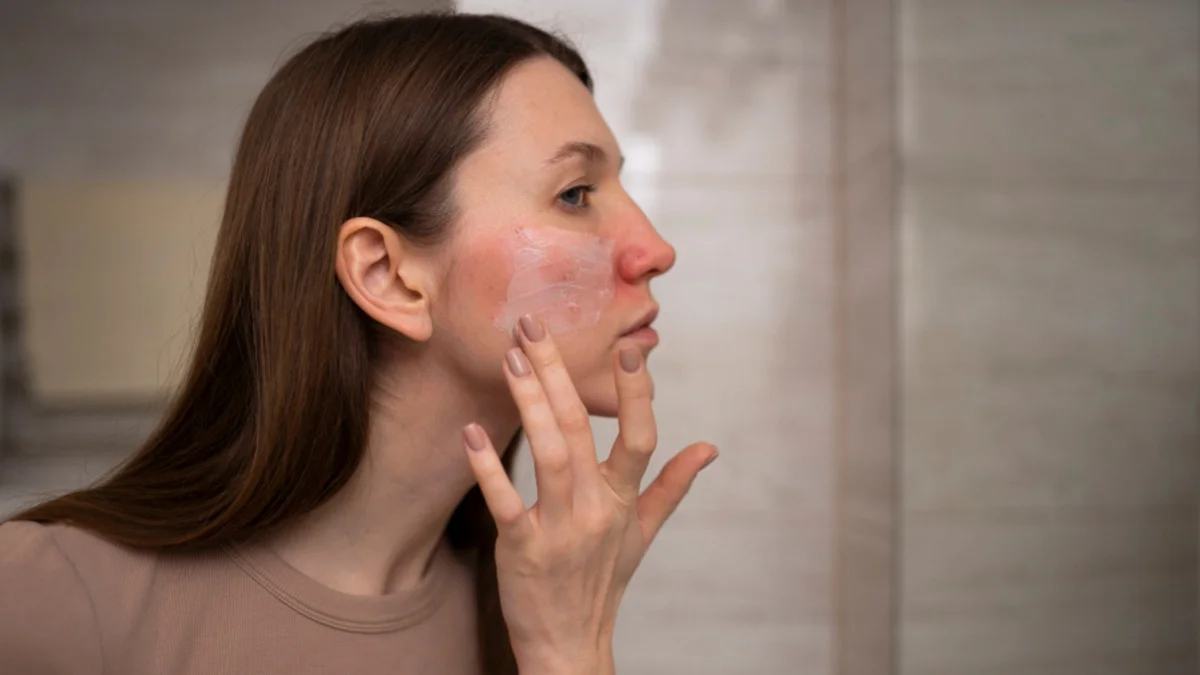
The appearance of eczema on the face often differs from body eczema in the same individual. On the body, particularly on lichenified areas like the inner elbows and knees, eczema tends to present as thickened, dry, scaly plaques. On the face, eczema more commonly appears as diffuse redness, fine scaling, and skin that looks irritated and sensitized rather than thickened. This is partly because the thinner facial skin develops lichenification less readily than thicker body skin, and partly because the face is more reactive to environmental stimuli, producing a more acutely inflamed appearance.
Periorbital eczema, affecting the skin around and on the eyelids, is a particularly significant subtype. The eyelid skin is the thinnest on the body and reacts intensely to both endogenous and contact triggers. Allergic contact dermatitis to nail varnish, eye drops, eyelash extensions, and airborne allergens frequently presents on the eyelids even when the primary trigger makes contact at a distant site, because hands transfer allergens to the eyes repeatedly throughout the day.
Perioral eczema, around the mouth, is common in children and in adults who lick their lips, use fragranced lip products, or have contact sensitivity to ingredients in toothpaste including sodium lauryl sulphate and flavoring compounds such as cinnamic aldehyde.
Eczema on the Face vs Body: Key Differences
Skin thickness
• Face: thinner, more permeable
• Body: thicker, less permeable
Appearance
• Face: diffuse redness, fine scaling
• Body: dry plaques, lichenification
Lichenification
• Face: less common
• Body: common in chronic disease
Trigger sensitivity
• Face: higher, continuous exposure
• Body: lower, can be covered with clothing
Corticosteroid use
• Face: mild potency only, short courses only
• Body: broader potency range appropriate
Calcineurin inhibitor use
• Face: preferred first-line for sensitive sites
• Body: used but less prominent
Scarring risk
• Face: PIH less common but more visible
• Body: PIH present but less conspicuous
Treatment complexity
• Face: higher
• Body: lower
Eczema on Specific Facial and Body Sites
Eyelids
Eyelid eczema is among the most challenging facial presentations. The skin is thin, fragile, and in constant motion. Rubbing the eyes during an itch episode rapidly worsens inflammation. Allergen transfer from hands, cosmetics, and airborne particles is common. A patch test study published in Contact Dermatitis found that in patients presenting with eyelid dermatitis, over 50% had at least one positive contact allergen identified, with nickel, fragrances, and preservatives being the most frequent.
Treatment on the eyelids requires the most cautious approach of anybody site. Only the mildest corticosteroid formulations should be applied, and only briefly. Calcineurin inhibitors, particularly tacrolimus 0.03% in children and tacrolimus 0.1% in adults, are the preferred maintenance treatment for periorbital eczema because they do not carry the skin thinning or intraocular pressure risks associated with repeated corticosteroid use near the eye.
Around the Eyes and Forehead
The periorbital area more broadly, including the brow and upper cheeks, is frequently affected in adult facial eczema. In this zone, both endogenous atopic eczema and airborne contact allergies contribute, making patch testing important when the pattern does not fit a typical atopic distribution.
Around the Mouth
Perioral eczema presents as redness, scaling, and cracking at the corners of the mouth and the skin above the upper lip. Lip licking significantly worsens it: saliva contains enzymes including amylase and proteases that directly damage the perioral skin barrier. A study published in the British Journal of Dermatology confirmed that habitual lip licking and saliva contact are among the most consistent perpetuating factors in perioral and commissural eczema in both children and adults.
Neck and Upper Chest
The neck and upper chest are transitional zones between facial and body eczema. They share the sensitivity of facial skin but are thicker than true facial skin. Eczema in this area is particularly commonly triggered by fragranced products including perfume, aftershave, and fragranced deodorant, as well as by necklace metals and fabric collar contact. In adults, the neck is a common site of lichenification from chronic scratching, particularly at night.
Hands
Hand eczema is one of the most prevalent and most functionally impactful presentations of body eczema, distinct from facial eczema in almost every practical respect. Dyshidrotic eczema on the palms and fingers produces intensely itchy small blisters. Irritant contact hand eczema from frequent handwashing, detergent exposure, and glove use is common in healthcare and catering workers. A review published in the British Journal of Dermatology found that hand eczema affects approximately 10% of the general population and is significantly more prevalent in occupational groups with repeated wet work exposure.
The hands tolerate moderate to potent corticosteroid formulations better than facial skin because the stratum corneum is substantially thicker on the palms, and systemic absorption is proportionally lower. Urea containing creams at 10% concentration are particularly useful on the hands for managing thickened, lichenified, or cracked skin.
Body Flexures
The classic body eczema sites, including the inner elbows, backs of the knees, wrists, and ankles, present with the chronic, lichenified, dry plaques most people picture when they think of eczema. These areas tolerate moderate-potency corticosteroids well and are where proactive twice-weekly topical corticosteroid therapy between flares has the strongest clinical evidence base, confirmed in trials published in the British Journal of Dermatology on fluticasone propionate applied to previously affected sites.
Why Treatment Differs Between Face and Body
The treatment difference between facial and body eczema comes down primarily to corticosteroid safety on the face.
Topical corticosteroids reduce inflammation effectively on both the face and body, but repeated use on facial skin carries specific risks not present on body skin. These include skin atrophy (thinning), telangiectasia (visible blood vessels), perioral dermatitis, and, with prolonged periocular use, elevated intraocular pressure and risk of glaucoma. These risks are directly proportional to potency and duration of use, and they occur at lower thresholds on the thin facial skin than on body skin.
For this reason, NICE guidance and the British Association of Dermatologists both specify that only mild potency corticosteroids should be used on the face, for the shortest time necessary. Moderate-to-potent corticosteroids should not be used on facial eczema except under specialist supervision for very short treatment courses.
Calcineurin inhibitors as the preferred alternative for facial eczema
Topical calcineurin inhibitors, specifically tacrolimus ointment and pimecrolimus cream, are anti-inflammatory agents that work through a different mechanism from corticosteroids. Critically, they do not cause skin atrophy, do not affect intraocular pressure, and do not produce the vascular side effects of corticosteroids. This makes them the preferred maintenance treatment and the preferred anti-inflammatory agent for sensitive facial sites including the eyelids, periorbital area, and neck.
A randomized controlled trial published in the Journal of the American Academy of Dermatology confirmed that tacrolimus 0.1% ointment was significantly more effective than mild corticosteroid cream for facial and neck eczema in adults when used as a maintenance treatment over 12 months, with a superior safety profile for long-term use.
Pimecrolimus 1% cream is somewhat milder than tacrolimus 0.1% and is frequently preferred for facial use due to its lighter, less occlusive formulation, particularly on the face.
Both agents carry a black box warning in the US regarding theoretical malignancy risk from prolonged immunosuppression, though multiple long-term studies have not confirmed this risk in clinical use. &The European Academy of Dermatology and Venereology, the British Association of Dermatologists, and NICE all support their use for facial and sensitive-site eczema.
Moisturizers for Facial Eczema: What to Use
The same principles that govern body eczema moisturizer selection apply to the face, with additional considerations for the thinner and more reactive facial skin.
Fragrance free and preservative minimal formulations are non-negotiable on the face. The face is more prone to contact sensitization than most body sites, and the concentration of allergens required to trigger a reaction on facial skin is lower than on body skin.
Lightweight ceramide creams are better tolerated on the face than heavy ointments. Plain white soft paraffin, which is an excellent body emollient, is too occlusive for daytime facial use and is poorly tolerated cosmetically. It can be used sparingly on the eyelids at night as an occlusive seal.
Colloidal oatmeal-containing formulations and niacinamide at 2 to 5% are well tolerated on facial eczema and provide barrier support and anti-inflammatory benefit without the sensitization risk of fragranced or preserved products.
Apply facial moisturizer within 3 minutes of gentle cleansing while skin is slightly damp. Use a non-foaming, fragrance free, low pH cleanser. Avoid micellar waters containing high concentrations of surfactants, which can disrupt the facial barrier despite their gentle marketing positioning.
Conclusion
Facial eczema and body eczema are the same condition at a biological level but behave very differently in practice. The thinner, more reactive nature of facial skin, its continuous environmental exposure, and the treatment restrictions that apply near the eyes all make facial eczema a more complex management challenge than most body sites. Calcineurin inhibitors, ceramide based lightweight moisturizers, and strict avoidance of fragranced and sensitizing products are the cornerstone of facial eczema care. For body sites, particularly the hands and flexures, a broader range of emollient and corticosteroid options is available and can be used with more flexibility.
Disclaimer
This article is for informational purposes only and does not constitute medical advice. If you are concerned about eczema on your face, particularly around the eyes, or if symptoms are not responding to over-the-counter care, consult a doctor or dermatologist for an individualized assessment and treatment plan.
References
• NICE — Atopic eczema in under 12s: diagnosis and management (CG57): https://www.nice.org.uk/guidance/cg57
• NHS — Atopic eczema treatment: https://www.nhs.uk/conditions/atopic-eczema/treatment/
• National Eczema Association — Eczema on the face: https://nationaleczema.org/eczema/locations/face/
• Elias PM. Stratum corneum defensive functions: an integrated view. Journal of Investigative Dermatology. 2005: https://www.jidonline.org/article/S0022-202X(15)32719-2/fulltext
• Proksch E, Brandner JM, Jensen JM. The skin: an indispensable barrier. Experimental Dermatology. 2008: https://onlinelibrary.wiley.com/doi/10.1111/j.1600-0625.2008.00786.x
• Thyssen JP et al. Eyelid dermatitis: a review of aetiology, diagnosis and treatment. Contact Dermatitis. 2019: https://onlinelibrary.wiley.com/doi/10.1111/cod.13197
• Rietschel RL, Warshaw EM, Sasseville D et al. Common contact allergens associated with eyelid dermatitis. Dermatitis. 2007: https://journals.lww.com/dermatitis/abstract/2007/03000/common_contact_allergens_associated_with_eyelid.4.aspx
• Bauer A et al. Perioral contact dermatitis. Journal of the German Society of Dermatology. 2019: https://onlinelibrary.wiley.com/doi/10.1111/ddg.13818
• Molin S et al. Lip licking dermatitis and saliva contact as a perpetuating factor in perioral eczema. British Journal of Dermatology. 2011: https://academic.oup.com/bjd
• Fowler JF et al. Hand eczema: prevalence and burden in occupational groups. British Journal of Dermatology. 2019: https://academic.oup.com/bjd/article/181/4/721/6699001
• Reitamo S et al. Tacrolimus ointment does not affect collagen synthesis: results of a single-centre randomised trial. Journal of Investigative Dermatology. 2004: https://www.jidonline.org/article/S0022-202X(15)30625-9/fulltext
• Paller AS et al. Tacrolimus ointment is more effective than pimecrolimus cream for facial and neck atopic dermatitis in adults. Journal of the American Academy of Dermatology. 2005: https://www.jaad.org/article/S0190-9622(05)01572-5/fulltext
• Luger T et al. Recommendations for pimecrolimus 1% cream in the treatment of mild-to-moderate atopic dermatitis. Journal of the European Academy of Dermatology and Venereology. 2013: https://onlinelibrary.wiley.com/doi/10.1111/jdv.12137
• Van Der Meer JB et al. The carryover effect of short-term twice-weekly applications of fluticasone propionate 0.005% cream in patients with atopic dermatitis. British Journal of Dermatology. 1999: https://academic.oup.com/bjd/article/141/6/1072/6699217
• British Association of Dermatologists — Topical corticosteroids: guidance on appropriate use: https://www.bad.org.uk/pils/topical-steroids/
• Langan SM, Irvine AD, Weidinger S. Atopic dermatitis. The Lancet. 2020: https://www.thelancet.com/journals/lancet/article/PIIS0140-6736(20)31286-1/fulltext



