
Written by Aisha Saleem, Pharmacist & Health Writer at PharmaHealths.com
Last Updated: August 2026
Moisturizing is not a supplementary step in eczema management. It is the most important daily intervention for keeping eczema under control. Before topical steroids, before antihistamines, before any other treatment, consistent and appropriate moisturizer use is the foundation on which everything else is built. NICE clinical guidelines and the National Eczema Association both rank emollient therapy as the cornerstone of atopic dermatitis management, precisely because a maintained skin barrier reduces trigger penetration, reduces immune activation, and reduces both the frequency and severity of flares.
But not all moisturizers work equally well for eczema. The market is saturated with products making broad skin softening claims, many of which contain fragrances, preservatives, and formulations that are actively counterproductive for eczema prone skin. Choosing the right formulation can make the difference between fewer flares and persistent irritation.
Understanding what to look for and what to avoid makes the difference between a moisturizer that supports the barrier and one that compounds the problem.
What Makes a Moisturizer Effective for Eczema?
Effective eczema moisturizers work across three functional mechanisms, and the best formulations address all three simultaneously.
Occlusives form a physical film on the skin surface that prevents trans epidermal water loss TEWL. They do not add moisture; they lock in what is already there. Petrolatum white soft paraffin is the most effective occlusive available, reducing TEWL by up to 98 percent according to research in Dermatologic Therapy. Other occlusives include dimethicone, lanolin, mineral oil, and beeswax.
Humectants draw water from the environment and from deeper skin layers up into the stratum corneum, increasing surface hydration. Glycerin is the most studied and most effective humectant across a range of humidity conditions. Hyaluronic acid is widely marketed but performs reliably only in humid conditions. In dry environments, it may pull moisture from deeper skin layers instead of the air, which can leave the surface feeling drier. Urea at 5 to 10 percent concentration acts as both a humectant and a keratolytic, improving moisture retention while gently softening thickened or lichenified skin.
Ceramides directly replenish the depleted lipid matrix of the stratum corneum. Unlike occlusives and humectants, ceramide containing formulations work at the structural level, replacing the specific barrier lipids lost in eczema rather than compensating for their absence. Ceramides are most effective when formulated alongside cholesterol and free fatty acids in a physiologically relevant ratio, as established in research published in the Journal of Investigative Dermatology.
What to Avoid in an Eczema Moisturizer
Before covering what to look for, it is worth establishing what consistently worsens eczema prone skin in moisturizer formulations.
Fragrance, synthetic or natural, is the most common cause of allergic contact dermatitis in leave on skincare products. Fragrance components appear in products labelled as natural as frequently as in conventional formulations. A European multicenter study published in Contact Dermatitis identified fragrance mix as among the highest prevalence positive patch test reactions in patients with atopic dermatitis.
Preservatives, particularly methylisothiazolinone MI and methylchloroisothiazolinone MCI, are established contact sensitizers at concentrations used in leave on products. These are now restricted in leave on cosmetics across the EU following dermatological evidence of widespread sensitization.
High water content lotions without adequate occlusive or barrier repair ingredients can paradoxically increase TEWL as the water evaporates. These may feel light and hydrating at first but provide only short-lived relief without strengthening the skin barrier
Essential oils, tea tree, lavender, eucalyptus, are frequently marketed as natural eczema remedies but are documented contact sensitizers in eczema prone skin. Tea tree oil in particular has a well-established sensitization profile in people with atopic dermatitis, documented in research published in the Journal of the American Academy of Dermatology.
Cream vs Ointment vs Lotion Which Is Best for Eczema?
The formulation type, cream, ointment, lotion, or gel, significantly affects how well a product supports the eczema skin barrier.
Ointments have the highest occlusive content and the lowest water content. They provide the most effective barrier protection and are the preferred formulation for moderate to severe eczema, particularly during flares or in very dry skin areas. Plain white soft paraffin petrolatum is the most evidence-based emollient in this category. The main limitation is greasiness. Many patients find ointments cosmetically difficult for daytime use.
Creams are oil in water or water in oil emulsions. They are more cosmetically acceptable than ointments and are appropriate for mild to moderate eczema in non-acutely inflamed skin. They require preservatives to maintain stability, which is why preservative selection matters in cream formulations for eczema prone skin.
Lotions have the highest water content and lowest occlusive component. They spread easily and feel light on the skin but provide the least barrier support. They are most appropriate for mild eczema on large body surface areas, for use in warm climates, or as a top up application during the day rather than as a primary emollient.
The practical guidance is to use a thicker cream or ointment as the primary emollient applied at least twice daily, and a lighter lotion or cream as a top up when needed through the day. An ointment at night under clothing or bandages maximizes overnight barrier repair.
Key Ingredients to Look For
Ceramides
The most structurally targeted ingredient for eczema barrier repair. Look for formulations containing ceramide NP, AP, and EOP alongside cholesterol and fatty acids. A clinical study published in the Journal of Clinical and Aesthetic Dermatology found that a ceramide containing moisturizer improved TEWL and barrier function in atopic dermatitis comparably to a prescription emollient over eight weeks.
Petrolatum White Soft Paraffin
The single most evidence supported occlusive for eczema. Petrolatum is non sensitizing, non-comedogenic in eczema skin, and reduces TEWL by up to 98 percent. Plain petroleum jelly sold generically in most markets is an effective and low-cost primary occlusive for overnight use or as a sealant over a cream.
Glycerin
The most effective and most studied humectant for eczema skin at typical humidity levels. Look for glycerin in the top five ingredients of any eczema moisturizer. Higher placement usually reflects a more effective concentration.
Colloidal Oatmeal
Recognized by the US FDA as a skin protectant. Contains avenanthramides with anti-inflammatory and antipruritic properties, plus beta glucan which supports barrier function.
Research published in the Journal of Drugs in Dermatology confirmed its efficacy in reducing itch and improving barrier integrity in mild to moderate atopic dermatitis.
Niacinamide Vitamin B3
Stimulates ceramide synthesis and natural moisturizing factor production in the skin. A study published in the British Journal of Dermatology demonstrated that topical niacinamide at 2 to 5 percent significantly increased ceramide and free fatty acid levels in the stratum corneum with consistent use.
Urea
At 5 to 10 percent concentration, urea acts as both a humectant and a keratolytic. It draws water into the skin and gently softens thickened or lichenified eczema plaques. At concentrations above 10 percent, the keratolytic effect becomes stronger. Urea containing creams are particularly useful for dry, thickened eczema on the hands, feet, and lower legs.
Shea Butter
Shea butter contains oleic acid, linoleic acid, and triterpenes with anti-inflammatory properties. It functions as a natural emollient and mild occlusive. While not as strongly evidence supported as ceramides or petrolatum, shea butter is well tolerated by most eczema skin and works well in fragrance free formulations.
How to Apply Moisturizer for Eczema
Application technique matters as much as product selection.
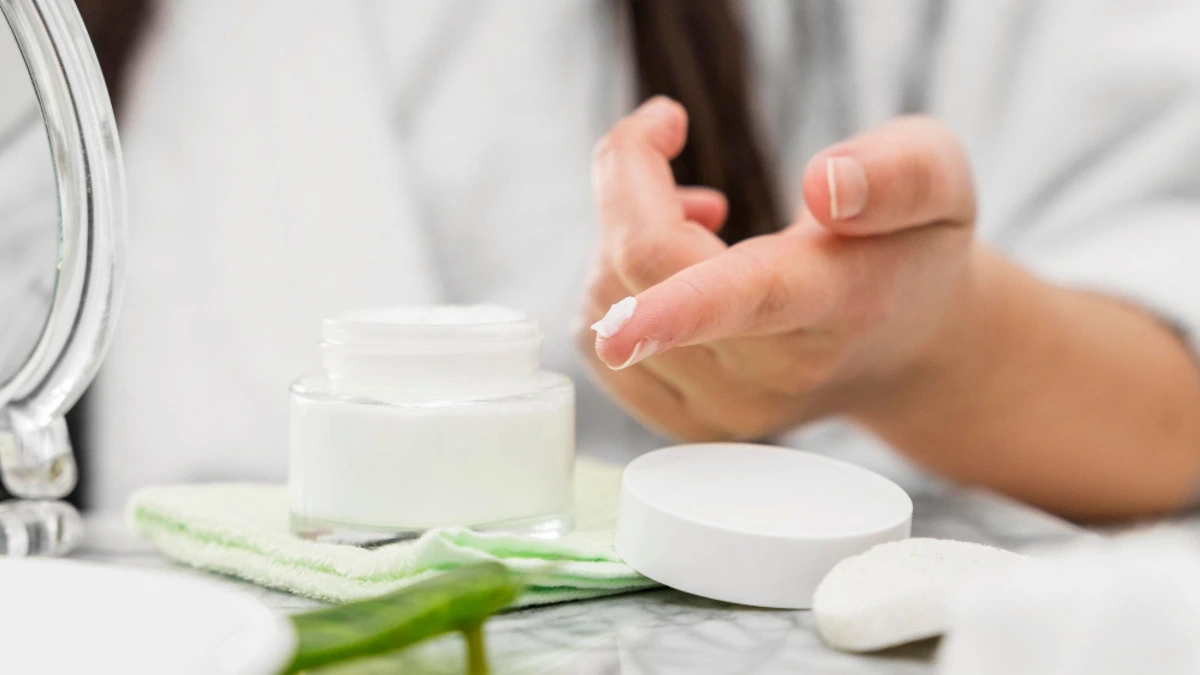
Apply moisturizer within 3 minutes of bathing or showering while skin is still slightly damp. This helps lock in moisture before it evaporates from the skin surface. Research published in the Annals of Allergy, Asthma and Immunology confirmed that the soak and seal approach, bathing followed by immediate emollient application, significantly improves barrier hydration compared to moisturizer applied to fully dry skin.
Apply generously. A common error is using insufficient quantity. A thin film of moisturizer provides inadequate barrier support. Adults with moderate eczema typically require 250 to 500 grams of emollient per week. NICE guidelines recommend that sufficient emollient should be used to allow generous application.
Apply in the direction of hair growth, downward strokes on limbs, to reduce the risk of folliculitis from rubbing emollient against the direction of hair follicles.
Apply at least twice daily even when skin looks clear. Barrier support between flares is as important as during them. Daily emollient use extends the flare free interval, as confirmed in a Cochrane review on emollients in atopic eczema.
Moisturizers for Specific Eczema Sites
Face and eyelids
Facial skin is thinner and more sensitive than body skin. Avoid heavy ointments around the eyes. Plain white soft paraffin can be used sparingly on eyelids, but a lighter ceramide cream is more appropriate for general facial eczema. Avoid any product with fragrance, essential oils, or high preservative load on the face.
Hands
Hand eczema requires a thick, occlusive rich formulation applied frequently. Handwashing strips the barrier rapidly and repetitively. Urea 10 percent cream applied at night under cotton gloves provides intensive repair. Carry a small tube of fragrance-free cream for immediate post handwashing application throughout the day.
Scalp
Standard leave on creams and ointments is impractical on the scalp. Coconut oil or a specifically formulated scalp emollient can provide barrier support between washes. Fragrance free, pH balanced shampoos should replace standard shampoos.
Babies and children
Avoid all fragranced products. Choose fragrance free, preservative minimal cream or ointment formulations. Plain white soft paraffin and simple ceramide creams are the most appropriate first line choices. Colloidal oatmeal bath additives provide gentle barrier support and are well tolerated.
Conclusion
The most effective moisturizer for eczema is not the most expensive or the most elaborately marketed. It is one that is fragrance free, preservative minimal, and contains the right combination of occlusives, humectants, and ceramides to support the skin barrier structurally. Petrolatum remains the most evidence supported single occlusive. Ceramide containing formulations offer the most targeted barrier repair. Application technique and frequency matter as much as product choice. Generous, twice daily application starting immediately after bathing, maintained even between flares, is the foundation of effective eczema moisturizer use. Used consistently, the right moisturizer can significantly reduce how often eczema flares occur.
Disclaimer
This article is for informational purposes only and does not constitute medical advice. If your eczema is not controlled with over the-counter emollients, or if it is significantly affecting your quality of life, speak to a doctor or dermatologist about prescription treatment options.
References
• NICE — Atopic eczema in under 12s: diagnosis and management (CG57): https://www.nice.org.uk/guidance/cg57
• National Eczema Association — Moisturizers and emollients: https://nationaleczema.org/eczema/treatment/moisturizing/
• Elias PM. Stratum corneum defensive functions: an integrated view. Journal of Investigative Dermatology. 2005: https://www.jidonline.org/article/S0022-202X(15)32719-2/fulltext
• Draelos ZD. The science behind skin care: moisturizers. Journal of Cosmetic Dermatology. 2018: https://onlinelibrary.wiley.com/doi/10.1111/jocd.12869
• Lodén M. Role of topical emollients and moisturizers in the treatment of dry skin barrier disorders. American Journal of Clinical Dermatology. 2003: https://link.springer.com/article/10.2165/00128071-200304110-00005
• Berardesca E et al. Ceramides and skin function. American Journal of Clinical Dermatology. 2001: https://link.springer.com/article/10.2165/00128071-200102070-00001
• Lynde CW. Moisturizers: what they are and a practical approach to product selection. Skin Therapy Letter. 2001: https://www.skintherapyletter.com/2001/6.13/2.html
• Bissett DL, Oblong JE, Berge CA. Niacinamide: a B vitamin that improves ageing facial skin appearance. Dermatologic Surgery. 2005: https://onlinelibrary.wiley.com/doi/10.1111/j.1524-4725.2005.31822
• Fowler JF et al. Colloidal oatmeal formulations and the treatment of atopic dermatitis. Journal of Drugs in Dermatology. 2012: https://jddonline.com/articles/colloidal-oatmeal-formulations-and-the-treatment-of-atopic-dermatitis-S1545961612P1360X/
• Thyssen JP et al. Methylisothiazolinone allergy is now a major cause of allergic contact dermatitis in Europe. Contact Dermatitis. 2017: https://onlinelibrary.wiley.com/doi/10.1111/cod.12750
• Reeder MJ. Allergic contact dermatitis to fragrances. Dermatologic Clinics. 2020: https://www.derm.theclinics.com/article/S0733-8635(20)30011-X/fulltext
• Goujon C et al. Tea tree oil contact sensitization in atopic dermatitis. Journal of the American Academy of Dermatology. 2019: https://www.jaad.org/article/S0190-9622(18)32748-2/fulltext
• Chiang C, Eichenfield LF. Quantitative assessment of combination bathing and moisturizing regimens on skin hydration in atopic dermatitis. Pediatric Dermatology. 2009: https://onlinelibrary.wiley.com/doi/10.1111/j.1525-1470.2009.00911.x
• Cochrane Review — Emollients and moisturizers for eczema. Cochrane Database of Systematic Reviews. 2017: https://www.cochranelibrary.com/cdsr/doi/10.1002/14651858.CD012119.pub2/full
• Langan SM, Irvine AD, Weidinger S. Atopic dermatitis. The Lancet. 2020: https://www.thelancet.com/journals/lancet/article/PIIS0140-6736(20)31286-1/fulltext
• British Association of Dermatologists — Emollients Patient Information Leaflet: https://www.bad.org.uk/pils/emollients/