
Written by Aisha Saleem, Pharmacist & Health Writer at PharmaHealths.com
Last Updated: August 2026
Eczema and psoriasis are two of the most commonly confused skin conditions, and it is easy to see why. Both cause red, itchy, inflamed skin. Both can flare and settle unpredictably. And both are chronic, meaning they tend to stay with you long term rather than clearing up after a single course of treatment.
But they are not the same condition. They have different causes, different appearances, different triggers, and different treatment pathways. Getting the right diagnosis matters because treating eczema with a psoriasis protocol, or vice versa, can lead to weeks or even months of poor control and ongoing discomfort.
As a pharmacist, I see patients confused about this all the time. This guide breaks down exactly how to tell the difference, what each condition looks and feels like, and when to seek a proper diagnosis.
What Is Eczema?
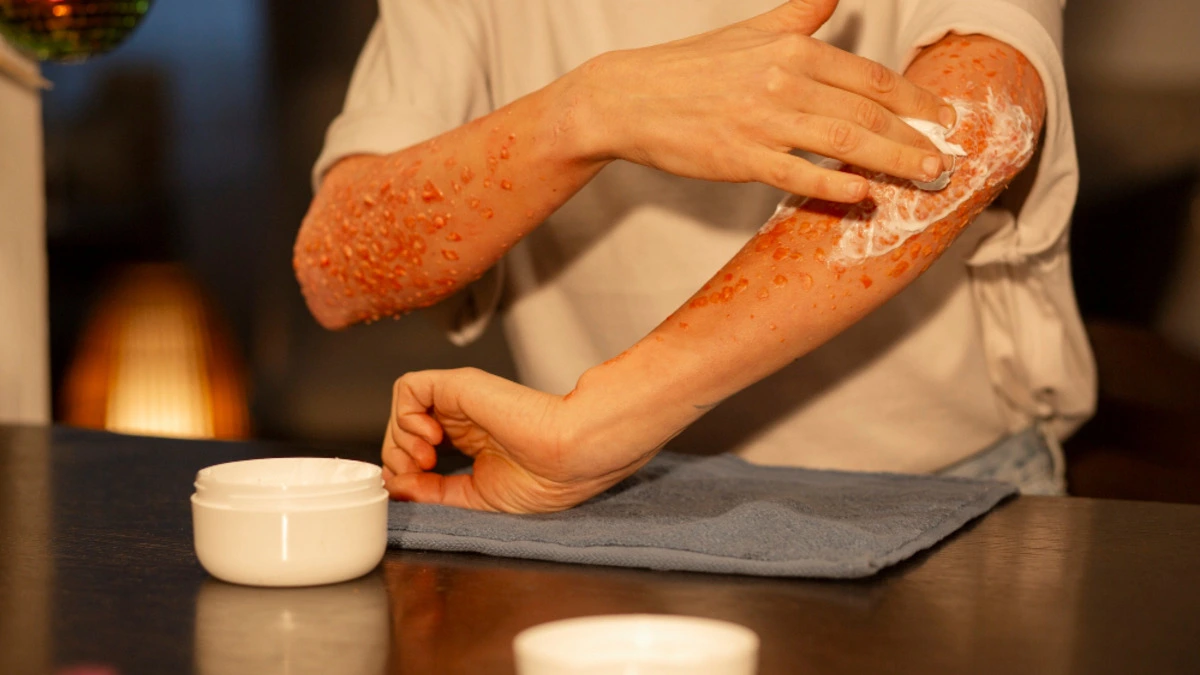
Eczema, most commonly atopic dermatitis, is a chronic inflammatory skin condition where the skin barrier is weakened, allowing moisture to escape and irritants to enter. The result is dry, intensely itchy, inflamed skin that can crack, weep, and blister.
According to the National Eczema Society, eczema affects approximately 1 in 5 children and 1 in 10 adults in the UK. It tends to begin in childhood, though adult-onset eczema is increasingly common.
The skin barrier dysfunction in eczema is closely linked to mutations in the filaggrin gene, a protein critical for maintaining a healthy skin barrier. Research published in the Journal of Investigative Dermatology has established filaggrin deficiency as a major genetic risk factor for atopic dermatitis.
Eczema is also closely associated with the atopic triad. Eczema, asthma, and hay fever often appear together in the same individual or family.
Where does eczema appear?
Eczema most commonly affects the inside of the elbows, the backs of the knees, the wrists, the neck, and the face, particularly around the eyes. In infants, it often starts on the cheeks and scalp.
What does eczema look like?
• Red to brownish grey patches
• Dry, sensitive skin
• Intense itching, often worse at night
• Small raised bumps that may weep fluid when scratched
• Thickened, cracked, or scaly skin
• Raw, swollen skin from scratching
What Is Psoriasis?
Psoriasis is a chronic autoimmune condition where the immune system mistakenly accelerates the skin cell cycle. Normal skin cells take around 28 days to mature and shed. In psoriasis, this process happens in as little as 3 to 5 days, causing cells to build up rapidly on the surface and form the thick, scaly plaques the condition is known for.
The NHS estimates that psoriasis affects around 2% of people in the UK. Globally, prevalence varies by region, but psoriasis is estimated to affect roughly 0.5% to 3% of the population, with around 40 million people living with the condition worldwide. Unlike eczema, psoriasis is driven primarily by immune system overactivity, specifically an excess of T cell activity triggering inflammation in the skin.
A study published in Nature Reviews Immunology identified the IL 17 and IL 23 pathways as central to psoriasis pathogenesis, which is why many modern biologics, including secukinumab and ixekizumab, specifically target these pathways.
Psoriasis also carries a significant systemic burden. Up to 30% of people with psoriasis develop psoriatic arthritis, according to research published in the Annals of the Rheumatic Diseases, causing joint pain, stiffness, and swelling alongside skin symptoms.
Where does psoriasis appear?
Psoriasis most commonly affects the scalp, elbows, knees, lower back, and nails. Unlike eczema, it tends to appear on the outer surfaces of joints rather than the inner creases.
What does psoriasis look like?
• Raised, inflamed patches covered with thick, silvery white scales
• Dry skin that may crack and bleed
• Itching, burning, or soreness
• Thickened, pitted, or ridged nails
• Swollen and stiff joints in psoriatic arthritis
Eczema vs Psoriasis: Side by Side Comparison
Understanding the differences becomes much easier when you look at key features side by side:
Cause
• Eczema: Skin barrier dysfunction combined with an immune response
• Psoriasis: Autoimmune condition driven by overactive T cells
Appearance
• Eczema: Red, weeping, or crusted patches
• Psoriasis: Thick plaques with silvery white scales
Itch Level
• Eczema: Intense and often difficult to resist
• Psoriasis: Moderate to severe, often with burning or stinging
Common Locations
• Eczema: Inner elbows, behind knees, face, and neck
• Psoriasis: Outer elbows, knees, scalp, and lower back
Skin Texture
• Eczema: Dry, cracked skin that may weep
• Psoriasis: Thick, raised, and scaly skin
Age of Onset
• Eczema: Often begins in childhood
• Psoriasis: Can occur at any age, commonly between 15 to 35 and 50 to 60
Associated Conditions
• Eczema: Asthma, hay fever, and food allergies
• Psoriasis: Psoriatic arthritis and increased cardiovascular risk
Contagious
• Eczema: No
• Psoriasis: No
Triggered by Stress
• Eczema: Yes
• Psoriasis: Yes
Biologic Treatments Available
• Eczema: Yes, including dupilumab
• Psoriasis: Yes, including secukinumab, adalimumab, and others
How to Tell the Difference: Key Visual Clues
The single most reliable visual distinction is the appearance of the skin itself.
Eczema patches tend to look raw, red, and weeping. The skin often appears inflamed and wet, especially after scratching. The edges of eczema patches are typically less defined, blending into surrounding skin.
Psoriasis plaques look entirely different. They are raised, thickened, and covered in a distinctive silvery white scale. The edges are sharply defined. If you gently scratch a psoriasis plaque, the scale comes away in flakes, a feature called the Auspitz sign where tiny pinpoint bleeding occurs beneath the scale.
Location is also a strong clue. Eczema favors the flexural areas, the creases and folds of the body. Psoriasis favors the extensor surfaces, the outer, bony areas like the elbows and knees.
Itch quality differs too. Eczema itch is typically described as relentless and burning. Patients often report scratching until the skin bleeds. Psoriasis itch is present but tends to be less overwhelming, with patients more likely to describe burning or stinging alongside the itch.
Eczema vs Psoriasis on the Face
Both conditions can affect the face, but they tend to look and behave differently here.
Facial eczema most commonly appears around the eyes, on the eyelids, around the mouth, and on the cheeks. The skin looks red, dry, and irritated, sometimes with weeping or crusting around the eyelids.
Facial psoriasis is less common but tends to appear on the forehead, hairline, eyebrows, and the skin between the nose and upper lip. It presents with the same thick, scaly plaques seen elsewhere on the body, though the scale may be finer on the face than on the scalp or elbows.
Eczema vs Psoriasis on the Scalp
Scalp involvement is common in both conditions and is one of the most frequently confused presentations.
Scalp eczema tends to produce fine, greasy or dry flakes, often confused with dandruff. The scalp may feel intensely itchy and the skin can appear red and irritated.
Scalp psoriasis produces thicker, more adherent silvery white scale that extends beyond the hairline onto the forehead, ears, and back of the neck. The scale in scalp psoriasis is substantially heavier than dandruff and does not resolve with standard anti dandruff shampoos alone.
Eczema vs Psoriasis on the Hands
Hand involvement in eczema typically appears as dyshidrotic eczema, small, intensely itchy blisters on the palms and sides of the fingers, or as dry, cracked skin across the knuckles and backs of the hands.
Palmoplantar psoriasis affects the palms and soles with well defined, scaly plaques. It can also produce pustules, small pus-filled spots, in a variant called pustular psoriasis, which does not occur in eczema.
Triggers: What Sets Each Condition Off
Both eczema and psoriasis are triggered by stress, but their other triggers differ significantly.
Eczema triggers:
• Soaps, detergents, and fragrances
• Dust mites and pet dander
• Pollen and mold
• Certain foods in some individuals, particularly children
• Sweating
• Synthetic fabrics
• Cold, dry weather
Psoriasis triggers:
• Skin injury such as cuts, sunburn, or insect bites, known as the Koebner response
• Streptococcal throat infections
• Certain medications including lithium, beta blockers, and antimalarials
• Alcohol consumption
• Smoking
• Stress
• Hormonal changes
Can You Have Both Eczema and Psoriasis at the Same Time?
Yes, though it is uncommon. A small number of patients do carry diagnoses of both conditions simultaneously. This is sometimes referred to as psoriasis eczema overlap. In these cases, diagnosis requires careful clinical assessment and sometimes a skin biopsy to distinguish the contribution of each condition to different areas of the skin.
Research published in the British Journal of Dermatology has documented cases of concurrent atopic dermatitis and psoriasis, noting that the two conditions can coexist particularly in patients with a strong family history of both.
Are the Treatments the Same?
Not entirely, though there is some overlap, particularly at the biologic level.
Eczema treatment pathway:
• Emollients moisturizers as the daily foundation
• Topical corticosteroids for flares
• Topical calcineurin inhibitors such as tacrolimus and pimecrolimus
• Dupilumab Dupixent, a biologic targeting IL 4 and IL 13 pathways, approved for moderate to severe atopic dermatitis
• JAK inhibitors such as baricitinib and upadacitinib for adults who do not respond to dupilumab
Psoriasis treatment pathway:
• Topical corticosteroids and vitamin D analogues such as calcipotriol
• Coal tar preparations
• Phototherapy UVB narrowband
• Methotrexate and ciclosporin as systemic treatments
• Biologics targeting TNF alpha, IL 17, IL 23, or IL 12 23 pathways
The biologic landscape differs significantly between the two conditions. Dupilumab, which works so well in eczema, is not effective for psoriasis. Conversely, IL 17 biologics like secukinumab are highly effective for psoriasis but are not the standard of care for eczema. This is one reason accurate diagnosis is so important before initiating advanced treatment.
I have covered dupilumab in detail in a separate article. If you are exploring biologic options for eczema specifically, that is worth reading alongside this one.
When to See a doctor
See your doctor if:
• You are unsure whether your skin condition is eczema or psoriasis
• Your symptoms are not controlled with over-the-counter treatments
• The affected area is widespread, painful, or affecting your sleep and daily life
• You notice joint pain or swelling alongside skin symptoms, this could indicate psoriatic arthritis and needs early assessment
• Your skin becomes infected with increased redness, warmth, swelling, or pus
A dermatologist can usually diagnose both conditions clinically. A skin biopsy is rarely needed but may be used in cases where the two conditions overlap or the presentation is atypical.
How to Identify Eczema vs Psoriasis in Real Life
Start with these simple checks:
Look at the location
• Inside elbows, behind knees, neck, face suggests eczema
• Outer elbows, knees, scalp, lower back suggests psoriasis
Look at the surface
• Wet, raw, or crusty points towards eczema
• Thick, dry, silvery scaling suggests psoriasis
Check the itch
• Severe, persistent itching suggests eczema
• Burning or stinging with itch suggests psoriasis
Look at the borders
• Blurred, uneven edges suggest eczema
• Sharp, clearly defined edges suggest psoriasis
Check for other signs
• Allergies, asthma, sensitive skin suggest eczema
• Nail changes or joint pain suggest psoriasis
Simple rule:
• If it is very itchy and affects skin folds, think eczema
• If it is thick, scaly, and on outer joints, think psoriasis
If symptoms do not improve with basic care, or if the diagnosis is unclear, a medical review is always the safest step.
Conclusion
Eczema and psoriasis share surface similarities but are fundamentally different conditions. Eczema stems from a broken skin barrier and allergic immune response. Psoriasis stems from an overactive autoimmune process that accelerates skin cell turnover. Getting the distinction right through the appearance, location, triggers, and associated symptoms is the foundation for effective treatment.
If you are unsure which condition you have, do not self-treat indefinitely. A doctor appointment, and if needed a dermatology referral, can give you a clear answer and a treatment plan that actually matches your skin.
Explore More on PharmaHealths
If this article was helpful, I have covered several related topics in depth on PharmaHealths.com, including a detailed guide to dupilumab (Dupixent) for eczema, an overview of the different types of eczema, and a breakdown of biologic treatments for psoriasis. These articles sit alongside this one as part of our skin health series and are worth reading if you are navigating treatment decisions for either condition.
Disclaimer
This article is written for informational purposes only and does not constitute medical advice. Always consult a qualified healthcare professional before starting, stopping, or changing any treatment for a skin condition. If you are experiencing a severe flare, signs of skin infection, or joint symptoms alongside your skin condition, seek medical advice promptly.
References
• National Eczema Society, Atopic Eczema: https://eczema.org/information-and-advice/types-of-eczema/atopic-eczema/
• NHS, Eczema (Atopic Dermatitis): https://www.nhs.uk/conditions/atopic-eczema/
• NHS, Psoriasis: https://www.nhs.uk/conditions/psoriasis/
• Irvine AD, McLean WH, Leung DY. Filaggrin mutations associated with skin and allergic diseases. New England Journal of Medicine. 2011: https://www.nejm.org/doi/full/10.1056/NEJMra1011040
• Nestle FO, Kaplan DH, Barker J. Psoriasis. New England Journal of Medicine. 2009: https://www.nejm.org/doi/full/10.1056/NEJMra0804595
• Reich K. The concept of psoriasis as a systemic inflammation: implications for disease management. Journal of the European Academy of Dermatology and Venereology. 2012: https://onlinelibrary.wiley.com/doi/10.1111/j.1468-3083.2012.04490.x
• Menter A et al. Joint AAD-NPF guidelines of care for the management and treatment of psoriasis with biologics. Journal of the American Academy of Dermatology. 2019: https://www.jaad.org/article/S0190-9622(18)33001-3/fulltext
• Simpson EL et al. Two phase 3 trials of dupilumab versus placebo in atopic dermatitis. New England Journal of Medicine. 2016: https://www.nejm.org/doi/full/10.1056/NEJMoa1610020
• British Association of Dermatologists — Psoriasis Patient Information Leaflet: https://www.bad.org.uk/pils/psoriasis/
• British Journal of Dermatology — Concurrent atopic dermatitis and psoriasis: clinical and immunological considerations: https://academic.oup.com/bjd